Windows Doors Manufacturer

So, you're looking to buy a floating Sliding Door for an international project, huh? Well, it's not just about picking pretty glass or hiding the hardware. There's quite a bit more to consider. You need to look into things like the wall structure, the size of the opening, how heavy the door is, the capacity of the track, safety features, and the conditions for installation. Sometimes, a gorgeous-looking panel can end up failing if the wall wasn’t built to support it—you’d be surprised how often that gets overlooked.
Daniel Reed, who's a senior door-systems consultant at Apex Door Systems, puts it nicely: “The best floating door isn’t necessarily the most eye-catching one; it’s the one that moves smoothly, quietly, and safely every single day.” He’s got years of experience inspecting all kinds of setups—from homes to hotels and even commercial spaces. His tip? Before you place an order, make sure to review the engineering drawings, check the hardware certifications, see what adjustment ranges are available, and verify that replacement parts won’t be a nightmare to find.
This guide, called “10 Floating Sliding Door Buying Tips for Global Buyers,” is all about practical stuff that really matters across different markets. Things like climate exposure, how well the product is protected during shipping, glass specs, clearance at the floor, soft-close features, and the skills of local installers. Whether it’s a humid coastal apartment, a dry hotel hallway, or a busy retail entrance—these details count.
And hey, don’t just trust how it looks. A track that’s sleek and low-profile might seem fancy, but it could require super precise alignment. That big glass panel? Looks luxurious, sure, but its weight impacts how everything is fixed in place. And product descriptions often leave out the small, yet important details. That’s when you really need solid documentation—don’t just go on assumptions.
Remember, no checklist can catch every possible hiccup. Specifications might change along the way, installers can interpret drawings in slightly different ways, and real buildings are never perfectly straightforward. Great buyers leave some wiggle room for verification, testing, and adjustments before giving the final thumbs up.
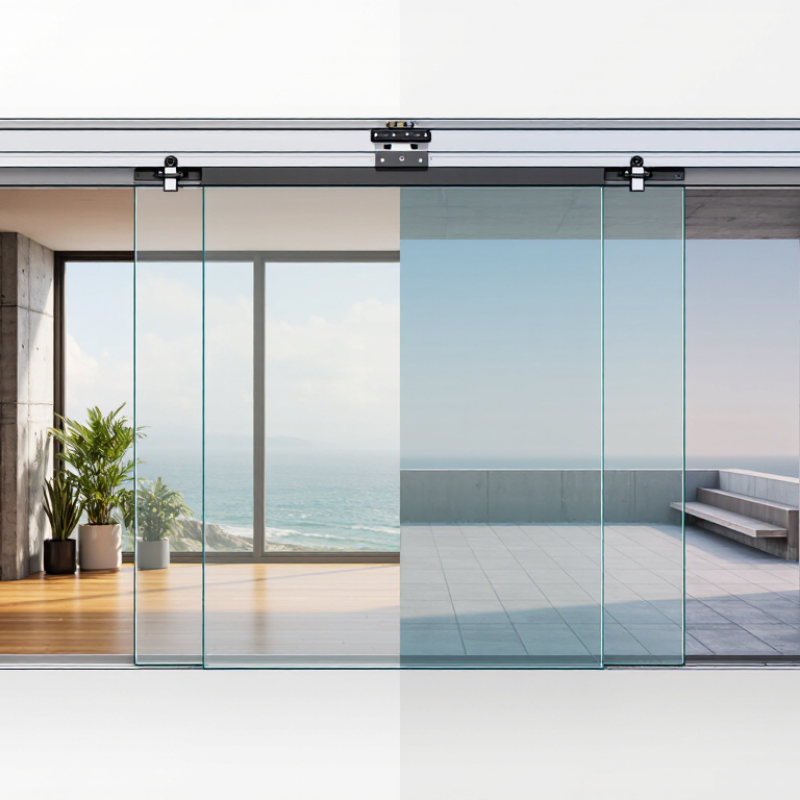
Floating sliding doors are top-hung systems with no floor track beneath the moving panel. The door weight transfers to an overhead rail, while small guides stabilize the bottom edge. This creates a cleaner threshold for homes, offices, hotels, and accessible interiors. However, “floating” does not mean maintenance-free.
Global buyers should inspect ten practical points: load rating, rail strength, roller quality, anti-jump protection, clear opening, wall structure, glazing weight, weather seals, thermal performance, and spare-part access. The supporting wall must carry dynamic loads, not only the panel’s static weight. A masonry wall may need reinforcement. A lightweight partition can be unsuitable. Check installation drawings before ordering.
Performance also depends on climate and application. The IEA’s Buildings 2023 report states that buildings consume about 30% of global energy and create around 26% of energy-related emissions. Poorly sealed glazed doors can increase drafts and cooling demand. Ask for tested air leakage, water resistance, and thermal data, rather than relying on attractive photographs. Relevant testing may include ASTM E283 for air leakage and recognized door performance standards in the destination market. For accessible spaces, verify the required opening width and operating force locally. Some systems glide beautifully during installation, then develop noise from dust or slight settlement. That possibility deserves attention. A modest service plan is often wiser than an impressive specification sheet.
A floating sliding door looks simple, but its opening must be measured like a small building project. Start with the finished floor, not rough concrete. Measure width at the top, middle, and bottom. Record the smallest number. Floors and walls are rarely perfect. Measure height at both jambs and the center, then check whether the header is level. A laser level helps, although a long spirit level still works.
Panel size needs more than the opening width. A single panel should cover the clear opening and overlap the fixed area enough to limit sight lines and drafts. Many installers allow roughly 50–75 mm of overlap per side, but the hardware instructions should control the final figure. Add space for the track, rollers, handle, and wall clearance. Floating systems can need a surprisingly flat wall. Check skirting boards, switches, sockets, curtains, and nearby furniture before ordering.
For a 900 mm opening, a 1,000–1,050 mm panel may be suitable, depending on the overlap and track design. Do not copy this example blindly. Glass weight, panel thickness, and ceiling height change the load and handling requirements. When considering Replacing Sliding Glass Door With French Door, remeasure the full swing zone, not only the existing opening. I have seen doors ordered correctly by width but blocked by a sofa or exterior step. A second site check feels excessive. It is cheaper than a remake.
When buying a Sliding Mesh Door For Main Door, compare the frame, glass, and finish as one system. Aluminum offers slim sightlines and strong corrosion resistance, but it can transfer heat quickly without a thermal break. Fiberglass resists warping and needs little maintenance. Wood feels warmer, yet it demands regular sealing in humid climates. uPVC insulates well, although large panels may require stronger internal reinforcement.
Glass selection changes comfort and safety. Low-emissivity glass can reduce heat transfer, while double glazing adds an insulating air or gas cavity. The U.S. Department of Energy reports that windows can cause 25–30% of household heating and cooling energy use. That figure makes glass performance worth checking, not guessing. Tempered glass breaks into smaller pieces; laminated glass stays bonded after impact. For windy or exposed sites, ask for tested air, water, and structural ratings under recognized fenestration standards.
Finish quality matters more than color alone. Powder-coated aluminum usually handles scratches and weather better than basic liquid paint, but preparation still decides durability. Dark finishes may absorb more solar heat. I have seen attractive doors become difficult to operate after poor installation. Measure drainage paths, track clearance, and wall movement before ordering. The International Energy Agency states that buildings account for about 30% of global final energy demand. Still, energy data cannot replace local climate advice. A technically efficient door may perform poorly when seals, rollers, or flashing are overlooked.
A floating sliding door should move quietly, stay aligned, and resist daily impact. Start with the track system. Inspect its load rating, corrosion resistance, adjustment range, and cleaning access. A concealed track looks elegant, but trapped dust can cause uneven travel. Floor guides should prevent swinging without creating a trip hazard. Ask for tested cycle data, not vague claims. One million cycles sounds impressive, yet poor installation can reduce performance sharply.
Hardware deserves equal attention. Choose rollers with sealed bearings and replaceable wear parts. Check the handle grip with wet or gloved hands. For heavy panels, an Automatic Door Closer For Sliding Door should control the final movement without slamming. Soft-closing hardware protects fingers, walls, and glass edges. The World Health Organization’s Global Report on Assistive Technology estimates that 2.5 billion people need assistive products today. Smooth, low-force operation therefore supports more users than appearance alone.
Safety testing must match the installation environment. Request evidence for impact resistance, pinch protection, glass safety, and repeated operation. The International Energy Agency reported that buildings used about 30% of global final energy in 2022. Poor seals around a sliding door can add drafts and noise. Check brush seals, meeting stiles, and frame tolerances. I have found that small alignment errors become obvious after winter. Do not trust a perfect showroom sample. Ask who services the track, how quickly parts arrive, and what performance changes after five years.
A Double Track Sliding Door can look simple, yet international projects often fail during small checks. Confirm the door’s test reports against standards accepted in the installation country. Safety glazing, finger protection, emergency release, and wind-load requirements may differ. Ask for complete performance documents, not only a product leaflet.
Climate suitability deserves equal attention. In humid regions, choose corrosion-resistant hardware and provide drainage beneath the track. Coastal air can damage untreated metal surprisingly quickly. In cold areas, check thermal movement, seals, and condensation control. Strong sunlight may also warp dark frames over time. I once saw a new door drag after a hot afternoon because the expansion gap was too narrow.
Installation conditions must be measured before ordering. Check the opening width, head height, floor level, wall strength, and nearby electrical routes. A heavy panel needs secure support, especially with a Double Track Sliding Door system. Leave practical adjustment space for rollers and seals. The installer should verify clearances on site, not trust drawings alone. That sounds obvious. It is often missed.
Local professionals should confirm applicable building and accessibility rules. Requirements can change between regions, even within one country. Request maintenance instructions in the working language. Include cleaning frequency, roller inspection, and replacement intervals. My own checklist is useful, but imperfect; unexpected substrate movement still causes problems. Build in a final inspection before handover.
International buyers should verify performance, climate suitability, and installation requirements before selecting a floating sliding door system.
The chart presents a practical verification priority score from 1 to 5, based on internationally recognized test areas. Check air permeability under EN 12207, watertightness under EN 12208, wind resistance under EN 12210, thermal performance using ISO 10077-1, corrosion resistance using ISO 9227, and installation requirements under EN 14351-1 or ASTM E2112 where applicable. Scores are purchasing-planning priorities, not product certifications.
Buying a floating sliding door globally starts with supplier evidence, not catalog photos. Request factory audit records, material certificates, load tests, installation drawings, and recent export references. The World Bank’s Logistics Performance Index 2023 highlights customs, tracking, and delivery timeliness as core logistics measures. Ask suppliers to score themselves against these points. Then verify answers with shipment documents or a video inspection. Photos can mislead. Field inspections often reveal weak rollers and incomplete hardware packs. That mistake becomes expensive after installation.
Compare a landed-cost sheet, not only the unit price. Include door panels, tracks, handles, protective packaging, inland transport, ocean freight, insurance, duties, taxes, and local unloading. UNCTAD’s Review of Maritime Transport 2023 states that shipping carries over 80% of global merchandise trade by volume. Freight disruption can change a quotation quickly. Request validity dates and two scenarios: standard freight and delayed delivery. A low quote may exclude crating or replacement parts. Check twice. Tie payment milestones to inspection, dispatch, and document release.
Warranty language should specify years, covered components, exclusions, response time, and return-freight responsibility. Ask whether rollers, seals, glass, and finishes can be replaced separately. After-sales support works only when spare parts have codes, drawings, and stock commitments. Send a test question before ordering: “How will you resolve a damaged panel?” Measure response speed and technical clarity. Tracking improves visibility, but it cannot repair a failed door. Keep installation photos, serial numbers, and signed handover records. My caution: even a strong warranty can disappoint when responsibilities remain vague.
| No. | Buying Area | What to Assess | Practical Benchmark or Requirement | Documents or Evidence to Request | Buyer Risk-Control Action |
|---|---|---|---|---|---|
| 1 | Supplier Capability | Confirm whether the supplier can manufacture the complete door system, including panels, track, rollers, handles, seals, and installation accessories. | A qualified supplier should provide a stable technical specification, production lead time, quality-control procedure, and spare-parts plan rather than only a product photograph. | Factory profile, product catalogue, process flow, quality-control checklist, production photographs, and at least two recent export references with contact details. | Use a written specification and compare at least three technically equivalent quotations. Do not select solely on the lowest unit price. |
| 2 | Door Configuration | Check opening width, height, panel count, stacking direction, wall clearance, floor condition, and whether the design is top-hung or floor-supported. | The track, wall structure, and roller capacity must be engineered for the actual door weight. A structural review is necessary for large or multi-panel systems. | Dimensioned shop drawing, installation section, load calculation, panel-weight calculation, and maximum recommended panel dimensions. | Approve drawings before production. Treat any change to glass thickness, frame material, or panel size as a new engineering review. |
| 3 | Glass and Hardware Specification | Verify safety-glass type, thickness, edge treatment, roller material, track finish, anti-jump devices, soft-close parts, locks, and seals. | Use tempered or laminated safety glass where required by the project and local building rules. Hardware should have a stated load rating and corrosion-resistance specification. | Glass marking or certificate, hardware load rating, material descriptions, finish sample, corrosion-test information where relevant, and approved hardware schedule. | Never accept “safety glass” as a sufficient description. Record the glass construction, thickness, treatment, and applicable standard in the purchase order. |
| 4 | Pricing and Total Cost | Separate product price from engineering, packaging, inland transport, freight, insurance, customs duty, taxes, installation, and payment charges. | For planning only, a custom residential floating sliding-door system may range from approximately USD 1,500 to USD 8,000 before destination charges, depending on size, glass, hardware, finish, and quantity. | Itemized pro forma invoice, Incoterms® 2020 quotation, packing dimensions, gross weight, payment schedule, tooling charges, and validity period. | Compare landed cost, not factory price. Ask the supplier to identify every excluded cost and confirm whether spare parts are included. |
| 5 | Samples and Pre-Production Approval | Evaluate finish, movement, alignment, noise, soft-close performance, handle operation, glass appearance, and packaging quality before bulk production. | A sample or approved pre-production unit should match the final bill of materials and drawings. A digital rendering alone cannot verify sliding performance. | Physical sample, finish swatches, approved drawings, signed golden sample record, and pre-shipment inspection criteria with measurable tolerances. | Keep a signed sample record with photographs. State that deviations require written approval before shipment. |
| 6 | Compliance and Safety | Match the product to the destination country’s requirements for safety glazing, wind load, fire separation, accessibility, thermal performance, and building permits. | Requirements vary by country, climate zone, building type, and project location. Supplier documents do not replace approval by the local architect, engineer, or authority. | Relevant test reports, declarations of performance where applicable, material certificates, installation instructions, and project-specific engineering calculations. | Identify the governing local code before ordering and obtain written confirmation from the project’s qualified professional. |
| 7 | Packaging and Damage Prevention | Review protection for glass edges, corners, tracks, rollers, finishes, and small hardware during multimodal transport. | Use rigid crates or reinforced export packaging, internal separators, moisture protection where appropriate, shock protection, and clear component labeling. | Packaging specification, crate photographs, packing list, gross and net weights, carton or crate dimensions, and loading photographs. | Require an inspection before container sealing and photograph the shipment condition. Confirm the claims procedure before dispatch. |
| 8 | Shipping and Import Planning | Assess transport mode, shipment volume, port handling, customs classification, delivery address, unloading equipment, and final-mile access. | Ocean freight is usually more economical for bulky door systems; air freight is faster but generally much more expensive. Transit time excludes production, customs clearance, and local delivery. | Commercial invoice, packing list, transport document, HS-code proposal, country of origin, cargo insurance terms, and shipping schedule. | Confirm the exact Incoterm®, named place, responsibility for unloading, and who handles customs. Use a customs broker for unfamiliar import procedures. |
| 9 | Warranty Terms | Check coverage, duration, exclusions, geographic limits, start date, labor responsibility, glass-breakage treatment, and finish or corrosion limitations. | A written warranty of approximately 2–5 years is a common commercial planning range for hardware or system components, but the actual term must be confirmed contractually. | Signed warranty document, spare-parts schedule, maintenance requirements, claim forms, response-time commitment, and replacement or refund procedure. | Ensure warranty promises appear on the purchase contract and define whether replacement parts, freight, labor, and installation are covered. |
| 10 | After-Sales Support | Evaluate technical communication, installation assistance, spare-parts availability, troubleshooting capability, and escalation procedures. | A dependable support process should include a named contact, documented response times, installation manuals, adjustment instructions, and commonly needed replacement hardware. | Service-level agreement, installation video or manual, spare-parts price list, exploded assembly diagram, support contact details, and case-resolution records. | Buy a reasonable spare-parts kit with the original shipment and retain all serial numbers, drawings, photographs, and maintenance records for future claims. |
Check the track load rating, corrosion resistance, adjustment range, and cleaning access. The panel should move quietly and stay aligned. Ask for tested cycle data, not broad promises.
Not always. Dust can collect inside a concealed track and cause uneven movement. Provide access for cleaning and maintenance before choosing this design.
Use sealed rollers and soft-closing hardware with replaceable wear parts. A controlled closer should slow the final movement. This protects fingers, walls, and glass edges.
Request documents covering impact resistance, pinch protection, glass safety, and repeated operation. Evidence should match the installation environment. A showroom sample proves very little.
Humidity and coastal air can quickly damage untreated metal. Cold areas require careful seal and condensation checks. Strong sunlight may expand dark frames and restrict movement.
Measure opening width, head height, floor level, wall strength, and nearby electrical routes. Confirm clearances for rollers and seals. Drawings alone are risky.
Choose a low-force handle and smooth movement. Test the grip with wet or gloved hands. Small details matter for users with limited strength.
Include track cleaning, roller inspections, seal checks, and replacement intervals. Ask how quickly spare parts can arrive. Five-year performance may differ from day-one performance.
Small installation errors can become obvious during winter or after hot afternoons. Confirm floor guides, expansion gaps, and panel clearances before handover. I still find checklists imperfect.
Choosing the right Floating Sliding Door requires more than comparing appearance and price. Global buyers should first understand how floating sliding door systems work and where they are suitable, then measure the opening, wall structure, panel dimensions, clearance, and operating space accurately. Material selection should reflect the project’s design, durability, maintenance needs, and climate, while glass types, colors, coatings, and finishes should be evaluated for privacy, light control, and long-term performance.
Buyers should also compare track systems, rollers, hardware quality, safety features, load capacity, noise control, and ease of operation. Before ordering, confirm applicable international standards, local building requirements, weather resistance, and installation conditions. A reliable supplier should provide clear specifications, transparent pricing, secure packaging, shipping support, installation guidance, warranty terms, and responsive after-sales service. Reviewing samples, technical documents, lead times, and total landed costs can help prevent unexpected issues and ensure the selected door performs safely and consistently across different markets.